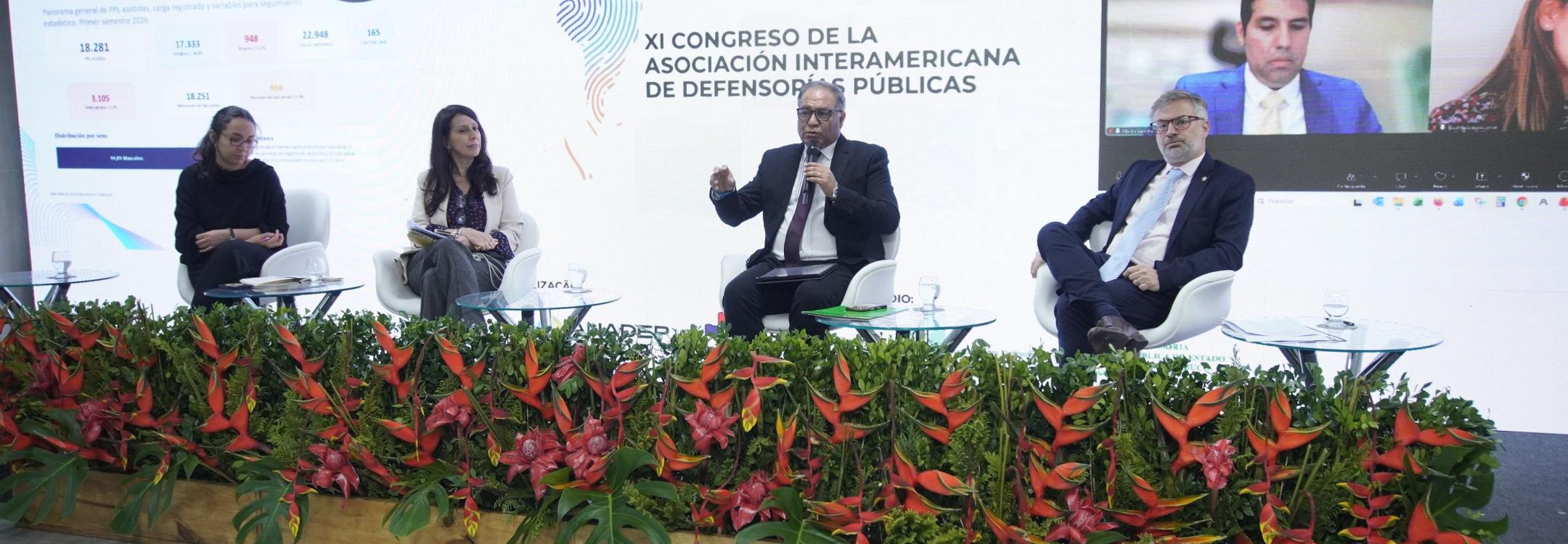
At the XI Congress of the Inter-American Association of Public Defenders (AIDEF) in Recife, Brazil, the APT highlighted the critical role of public defenders in preventing torture and ill-treatment and promoting a shift from coercive interrogation to effective, rights-based interviewing.
The APT joined a panel examining the role of public defenders in protecting human rights in the criminal justice system and prisons. The contribution focused on a particularly important moment for torture prevention: the questioning of people suspected of crimes and the role defence lawyers can play in ensuring that interviews are conducted lawfully, effectively and without coercion.
The discussion provided an opportunity to launch the Portuguese and Spanish translations of the Toolkit for Defence Lawyers: Applying the Méndez Principles in Legal Practice, developed by the APT and the International Bar Association’s Human Rights Institute (IBAHRI), making the publication available in two additional languages.
The Toolkit is designed to support defence lawyers in translating the Méndez Principles into everyday legal practice.
The main message of APT’s contribution was straightforward: the purpose of an investigative interview is to obtain accurate and reliable information, not to secure a confession.
The Méndez Principles are grounded in scientific, legal and ethical standards. Research underpinning the Principles shows that coercion does not produce more accurate information and increases the risk of false confessions.
APT’s presentation contrasted coercive practices – including inducing high levels of stress, suggestive questioning and confirmation bias – with an effective interviewing approach based on building rapport, respect and dignity, genuine empathy, active listening, open and non-leading questions, and the implementation of procedural safeguards.
Public defenders as a safeguard against coercion
Defence lawyers have a particularly important role in making these standards a reality.
Their work begins before the formal interview. They can review case files and police notes, examine the circumstances of any previous statements or informal conversations, identify heightened vulnerabilities, meet their client confidentially and insist on being present during interviews.
The Toolkit describes defence lawyers as a first line of defence in ensuring that safeguards and interviewing standards are respected in practice. Their responsibilities can include protecting clients from coercion, monitoring interview practices, advising clients about their rights and activating accountability mechanisms where necessary.
This role is especially significant during the first stages of detention. The Toolkit notes that the early moments of custody carry particularly high risks of torture and ill-treatment, when people may be isolated, unaware of their rights and exposed to intense pressure. Coercive practices at this stage can lead not only to abuse but also to unreliable information, false confessions and miscarriages of justice.
Turning international standards into everyday practice
The discussion in Recife also underscored a broader objective of the Toolkit: transforming international standards into practical tools that defence lawyers can use in different national contexts.
The Toolkit for Defence Lawyers: Applying the Méndez Principles in Legal Practice brings together international and regional human rights standards with practical guidance for lawyers. It covers preparation for and participation in interviews, identification of torture and ill-treatment, challenges to unlawfully obtained evidence, access to remedies, cooperation with independent medical experts and engagement with oversight bodies and other criminal justice actors.
This is particularly relevant in the Americas, where the regional human rights framework protects personal integrity and liberty, guarantees fair-trial rights and the right not to be compelled to confess, alongside the protections contained in the Inter-American Convention to Prevent and Punish Torture.
Through its participation in the AIDEF Congress, the APT reinforced a core message of its work on criminal justice: preventing torture and strengthening effective justice are mutually reinforcing goals.
The APT hopes the new publication now available in Spanish and Portuguese will be an useful tool for lawyers and public defenders across Latin America on the frontline to uphold the implementation of safeguards in the first hours of detention, challenge evidence obtained under duress and advance justice systems grounded in dignity and fairness.