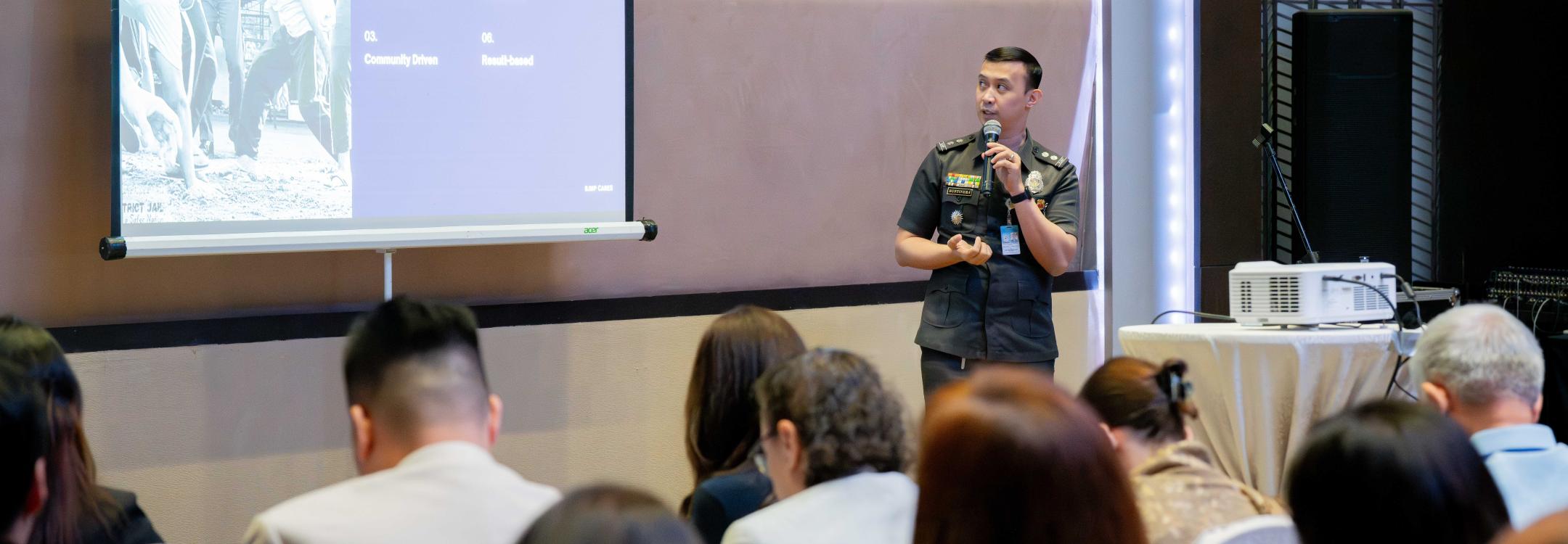
Overcrowding and excessive use of pre-trial detention continue to place people at serious risk of ill-treatment in the Philippines. The APT was recently in Manila and Quezon City to continue efforts on torture prevention.
Despite years of engagement and repeated reform efforts, detention facilities remain severely congested and safeguards in the earliest stages of custody are unevenly applied. At the same time, the visit revealed renewed momentum around independent oversight and National Preventive Mechanism (NPM) designation under the Optional Protocol to the Convention Against Torture (OPCAT).
The mission took place against the backdrop of a renewed national debate on decongestion, including discussions linked to a Justice Sector Coordinating Council–UNODC summit. Discussions with judges, parliamentarians, oversight bodies and civil society consistently pointed to pre-trial detention as the primary driver of overcrowding, compounded by slow case processing and limited use of non-custodial measures. While authorities can cite isolated initiatives, there is still no coherent, system-wide approach linking arrest practices, prosecutorial discretion, judicial decision-making and safeguards to sustainable reductions in detention.
During the mission, the APT Senior Adviser and Asia-Pacific Representative visited Manila City Jail, including the men’s and women’s dormitories. The visits illustrated the scale of the challenge. Both facilities were operating far beyond capacity, with the men’s dormitory at over 300% overcrowding and the women’s dormitory at over 580%.
The majority of people were still awaiting trial, many for several years. Conditions reflected chronic congestion, with basic services under severe strain and daily life shaped by shortages of space and resources. Although some improvements have been noted over the past decade, particularly in overall population reductions, overcrowding remains extreme and continues to heighten risks of ill-treatment.
A central theme emerging from the mission was growing recognition among justice sector actors that decongestion is not merely a logistical or budgetary issue, but a human rights imperative directly linked to the prohibition of torture and ill-treatment. At the decongestion summit, judges engaged in detailed discussions on the role of early and meaningful judicial oversight, including custody hearings, in reducing unnecessary detention and identifying abuse at the earliest stages. Comparative experiences from other jurisdictions illustrated how rights-oriented judicial practices can contribute to long-term decongestion.
The mission also focused on advancing dialogue on NPM designation. A multi-stakeholder meeting in Quezon City brought together parliamentarians, civil society and the Commission on Human Rights of the Philippines, which currently acts as an interim monitoring body. Participants broadly agreed that an NPM is urgently needed, particularly given persistent overcrowding, extensive pre-trial detention and gaps in safeguards. Fourteen years after ratifying OPCAT, there is renewed hope that this could be the year for formal NPM designation and strengthened torture prevention efforts in the Philippines.
Overall, the mission confirmed both the depth of the challenges and the existence of entry points for reform. Linking decongestion more explicitly to safeguards, early judicial oversight and independent monitoring will be critical if current momentum is to translate into lasting change.